
If you’ve been on our tours or read our books, you’ll know that when a doctor shows up in one of our stories, there’s usually something grim involved. Dr. Pirie, Dr. Templeman, and Dr. Crichton are practically part of the furniture at this point, and in 2024 we even devoted a full talk to Dr. Templeman, not just the gruesome cases but his relentless battle against tuberculosis. Back in 2019, our Curious Curers tour (in collaboration with Dundee Science Centre) gave us the chance to shine a light on some brilliant medical tales, including those of Dr. Patrick Blair and David Kinloch, physician to King James VI himself.
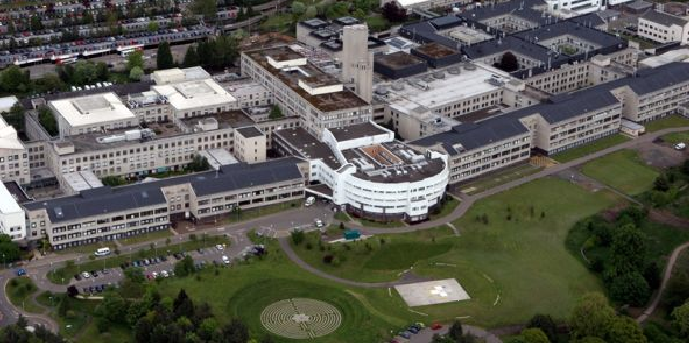
On our Vaults tour, we sometimes mention to people that one of the doctors in our stories, Dr. Arrott, has a road named after him near Ninewells Hospital. Turns out, he’s not the only one. So we thought it was high time we shared the stories behind all the medical minds immortalised in street signs around Ninewells.
George Pirie Way
Dr. George A. Pirie (1863–1929) was Dundee’s X-ray pioneer. Within months of their discovery in 1895, he threw himself into experimenting with their clinical possibilities at Dundee Royal Infirmary, founding its first Electrical Department in 1896. At the time, the dangers of radiation exposure were simply not understood, and Pirie paid a devastating price, losing both hands and the sight in one eye. He continued his vital work until 1925, when his health finally made it impossible to carry on.
He was recognised for his extraordinary contributions, receiving a Civil List pension, a Carnegie Hero Trust medal, and a public collection raised by the people of Dundee. His name is also inscribed on a memorial in Hamburg dedicated to early X-ray martyrs, with the words:
“They were heroic pioneers for a safe and successful application of X-rays to medicine. The fame of their deeds is immortal.”
The Medical History Museum in Dundee holds some of Pirie’s early X-ray equipment, including his fluoroscope, protective mask, and a bottle of mustard oil he used to ease the pain in his radiation-damaged hands. The Pathology department at Ninewells still keeps one of his hands, which was riddled with radiation tumours.
Worth knowing: if you hear us mention a Dr. Pirie in our crime stories it’s not this one, it’s actually his father, Dr. George Clark Pirie, police surgeon and medical officer for health, who has most recently featured in our Love Hurts talk. The medical talent clearly ran in the family!

Patrick Blair Place
Dr. Patrick Blair (c.1680–1728) wasn’t just a surgeon, he was a botanist, anatomist, and the first person in recorded history to dissect an elephant, right here in Dundee. When an elephant keeled over near Broughty Ferry in 1706, Blair saw an opportunity. The town’s provost, keen to get rid of the massive carcass, gave him the go-ahead but under armed guard, to stop locals nicking bits of elephant as souvenirs (or worse, for a wee taste, we’d expect nothing less from Dundonians).
Blair’s findings were groundbreaking, and he wrote them up in a paper for the Royal Society of London. His career later took a nosedive when he joined the Jacobite Rebellion in 1715. Captured and sentenced to death, he was saved at the very last minute thanks to some well-connected pals pulling strings. He eventually ended up in London and then Lancashire, where he died in 1728.
We’ve already got a full post about Blair on the website. Give it a read here if you want the full elephant-dissection experience.

James Arrott Drive
Dr. James Arrott (1808–1883) was head physician at Dundee Royal Infirmary from 1833 to 1855, first at its original home on King Street, and then as the driving force behind its move to a brand new building on Barrack Road (now, naturally, converted into fancy flats). Getting a hospital designed, funded, and built was no small feat, and Arrott was central to making it happen, with the support of Sir John Ogilvy, MP for Dundee.
A leading expert in tuberculosis and respiratory diseases, he worked tirelessly to improve public health at a time when Dundee’s rapid industrial expansion was taking a heavy toll on its people. He was also a police surgeon, which is why he’s turned up in both our Vaults: Echoes of the Past tour and our Death in the West End tour. Clearly, if you were a doctor in old Dundee, crime-solving came with the territory.

Thomas Maclagan Way
Dr. Thomas J. Maclagan (1838–1903) paved the way for one of the most widely used medicines in the world. While working at Dundee Royal Infirmary in the 1860s, he experimented with salicin, a compound extracted from willow bark, and found it effective in treating rheumatic fever. His research was later developed in Germany, eventually leading to the creation of acetylsalicylic acid. You might know it better as aspirin.
Maclagan also championed the clinical use of thermometers to measure fever, which was genuinely groundbreaking at the time. He later moved to London, where he became the go-to doctor for the rich and famous, including members of the Royal Family. Not bad for a lad from Dundee.
Kirsty Semple Way
Dr. Kirsty Semple (c.1924–1995) was a Dundee GP who went above and beyond for her entire career. She ran a practice on Strathmartine Road for 30 years, founded the Tayside Breast Care and Mastectomy Group in 1978, and helped set up the Tayside Council on Addictions. On top of all that, she was deeply involved in community and charitable work, running a tearoom for the homeless and supporting addiction recovery programmes.
She was once nominated as Dundee’s Citizen of the Year, but sadly passed away from cancer before the ceremony could take place.
On a lighter note, she was also the GP of Dundee legend Dudley D. Watkins, creator of The Broons. And supposedly, Watkins occasionally dressed Daphne Broon in outfits inspired by Dr. Semple’s own wardrobe, much to her annoyance, particularly since he never used them for the prettier Maggie.
James Black Place
Sir James Whyte Black (1924–2010) was a Nobel Prize-winning pharmacologist who genuinely changed medicine forever. Born in Uddingston and educated in Fife, he studied at University College, Dundee (now Dundee University, but then part of St Andrews University) and worked after graduation in the physiology department for a while, before going on to the rest of his career and his groundbreaking work – developing propranolol, the first beta-blocker, revolutionising the treatment of heart disease. He later created cimetidine, a landmark drug for stomach ulcers.
In 1988, he was awarded the Nobel Prize in Medicine. He went on to serve as Chancellor of the University of Dundee from 1992 to 2005, and was knighted in 1981. Despite his global success, he remained a proud Scot and left a legacy that is quite literally still saving lives today.
Thomas Wise Place
Dr. Thomas Alexander Wise (1802–1889) was a Dundee-born physician who spent much of his career in India with the Indian Medical Service, but left behind a legacy that stretches from Bengal to Dundee’s own McManus Galleries. Born near Dundee in 1802, he studied medicine at Edinburgh University before heading to India, where he worked as a physician and surgeon and founded the Hooghly Mohsin College in 1834 and the Hooghly Imambarah Hospital.
What makes Wise particularly extraordinary is the breadth of his curiosity – he wrote on subjects such as the Hindu system of medicine, diseases of the eye, insanity in Bengal, cholera, and the history of medicine. He also collected everything he could get his hands on, from Egyptian amulets to Irish copper axes to a spectacular set of maps of Tibet. In 2019, The McManus hosted an exhibition called Wise Ways: Travels of a Dundee Doctor, which reunited his objects with the Tibetan maps thanks to a loan from the British Library.
He retired on health grounds in 1851 and returned to Scotland, eventually settling in London where he died in 1889. The McManus exhibition put it well: this was a man who collected the world.
And those are just the streets with their own dedicated sections. When the staff housing was built to the southeast of the Ninewells site, the streets there were named after some of the giants of medical science too, including Simpson Avenue, Lister Place, and Pasteur Lane. Perhaps a post for another day!
Next time you wander past these streets near Ninewells, you’ll know exactly who you’re walking past. Whether they were pioneering X-rays at great personal cost, dissecting elephants under armed guard, laying the groundwork for aspirin, or transforming community healthcare in Dundee, these medics left their mark on the city, on medicine, and now, on street signs.
And if you fancy hearing more about the grisly side of Dundee’s medical past, come and join us on one of our tours or talks.